


Search the site

What is a great experience worth to you? All-inclusive dissected (Part 1/3)

This series of articles discusses the history, supply & pipeline of all-inclusive resorts globally and specifically in APAC (Part I), deep-dive into the business model (Part II), and a comparison across traditional resorts and two all-inclusive brand specifics (Part III).
Part I
History
It is not clear how far the origins of the all-inclusive concept date back in history. Traditional Ryokans in Japan offer meals, ‘Onsen’ hot springs, basic entertainment, and, of course, lodging – a form of all-inclusive accommodation that dates back more than 1300 years.
In more recent times, the UK saw the all-inclusive concept introduced in the form of Butlin’s holiday camps in the 1930s. The founder Billy Bultin’s background in theme parks and entertainment seems like a natural progression into hospitality. Adding red coat entertainers, however, was a novelty and huge success building on elements of entertainment and community. Butlin’s footprint expanded from England’s eastern shore at Lincolnshire, Essex, and Yorkshire, to Scotland, Wales, Ireland and on to the Bahamas in 1948. The concept remained one of camps with hotels added in some locations but was eventually disrupted by cheaper international travel by the 1980s.
Hardcoding sunshine into the concept saw a newcomer emerge in Majorca in 1950: Club Med founded by Gérard Blitz. While the first villages featured army tents without water or electricity as accommodation, the essence of freedom and sports was front and center. Over time, entertainment and ‘Gentle Organisers’ became a cornerstone of the experience, as facilities were gradually upgraded to feature more robust accommodation and exotic locations were embraced. First a small bungalow village at Tahiti in 1955, which required extensive boat travel, then a ski resort in Switzerland in 1956, and later two resorts in the French Caribbean. And the rest is history as they say.
An interesting shift that occurred in the industry is that in the past the market was mostly oriented towards a mass market product characterized by value offerings, larger inventories, and in low-cost destinations (North Africa, Turkey, and Caribbean). Over the last 10 years, there has been a gradual shift towards the luxury segment, with new players, such as Ikos, targeting very high-end destinations. This trend is still building momentum and opening up new opportunities.
Global Supply Landscape
True to its origins, of the total all-inclusive supply of approximately 755,000 keys (based on CoStar data), 46% are in Europe followed by the Americas at 40%. Predominant regions are the Mediterranean and the Caribbean. On a national level, this has Turkey at 134,000 keys ahead of Mexico with 121,000 keys, Spain at 85,000 keys is in third spot and the Dominican Republic at 63,000 keys comes in fourth. Other major markets include Greece (51,000), Cuba (42,000), Egypt (36,000), Bulgaria (25,000), and Jamaica (19,000). Both Middle East & Africa (MEA) and Asia Pacific (APAC) are far behind at less than 80,000 (Egypt, Tunisia, and Morocco represent 76% thereof) and 30,000 keys, respectively.
Detail: Pipeline to Existing Supply Ratio by Region

However, in terms of pipeline, a more compelling picture emerges. Clearly, the most dynamic growth in the sector is in APAC, where new supply represents 19.2% of existing supply. Nevertheless, the Americas leads with the strongest total pipeline at more than 23,000 keys. Countries with the largest pipeline include the Dominican Republic, Mexico, and Jamaica.
The operator landscape is highly fragmented, whereby the largest nine operators command only 30% market share.
Figure: Top 10 Global Operators by Existing Rooms

The traditionalist incumbents were vertically integrated travel enterprises owning travel agencies, (charter) airlines, destination management companies (DMCs), and all-inclusive resorts such as TUI. However, the stalwarts of industry can all trace their origins back to the Mediterranean island of Majorca in the 1950s. Aforementioned Club Med, Riu (with approximately 45,000 keys), Iberostar, TUI, Melia, and Barcelo all launched on this island where the post-war travel boom was unleashed most ferociously in the form of package holiday makers, just when the island became a luxury destination. Visits by Liza Minelli and Frank Sinatra made for unbeatable publicity back then.
Hyatt’s name emerged on the scene more recently after first launching their own two brands in 2013 and then doubling down by acquiring Apple Leisure Group in 2021 and Playa Hotels & Resorts in 2025. Both acquired groups had large existing room counts across the Caribbean and Mexico at around 29,000 and 9,000 keys, respectively. In December 2024, Hyatt also signed a strategic joint venture with Grupo Piñero of, which brings 22 of their resorts with 12,000 keys to Hyatt’s Inclusive Collection.
Notably, Accor has been active in the space and took market share in 2017 through its 50-50 joint-venture with all-inclusive operator Rixos, followed by the launch of the ‘All-Inclusive Collection’ in 2021. In April 2025 Accor entered negotiations for the acquisition of Royal Holiday Group’s management contracts with 3,200 keys – which should be concluded very soon.
In APAC, the Maldives registers the largest all-inclusive supply inventory tracing back to the island nations very roots in tourism in the 1970s. The ‘one island, one resort’ mantra is conducive to the all-inclusive business model given the captive audience. In general, all-inclusive resorts have first thrived in less developed locations in APAC. Conversely, ranging from island resorts in Okinawa, to hot spring resorts and ski resorts in the north, Japan looks at a sizeable inventory rooted in its Ryokan history. The two giant nations of China and India are neck-to-neck, right behind Japan. However, in other parts of Asia, the business model has not caught on to the same extent as in Europe and the Caribbean, attributable to the evolution of travel and distance to high-spending source markets across various stages of tourism development.
APAC Pipeline
The most dynamic pipeline growth in APAC is in the most active hotel development market in Southeast Asia: Vietnam - though coming off a very low base. Given the abundance of affordable options for dining and entertainment proximate to most resorts mixed with the omnipresence of major hotel chains and their loyalty programs vis-à-vis fragmented source markets, the all-inclusive model struggles to gain traction.
Figure: APAC Pipeline to Existing Supply Ratio by Country

The pipeline for all-inclusive resorts in APAC stands just shy of 5,000 keys, which is a fraction of the close to 1 million keys of branded supply pipeline.
Due to factors mentioned above, the number of pure all-inclusive operators in APAC is limited. In most cases, certain owners and operators choose to run a specific property as an all-inclusive due to certain operational constraints or limitations. They may well maintain a ‘regular’ resort brand for marketing purposes.
Figure: APAC Existing Room Supply by Brand

Given its legacy in the industry that includes a long presence in the region, Club Med has the largest footprint in APAC with approximately 22% of the existing all-inclusive supply. Second largest in APAC is Japanese Iconia Hospitality’s Kamenoi brand (under Fortress Investment Group) at roughly 5% of the total existing supply.
As traditional operators gain more experience with the all-inclusive business model in the region, it gets deployed more frequently. The mix of operators with strong pipelines shows that having the right expertise and focus is critical in scaling up.
Detail: APAC Pipeline Supply by Operator
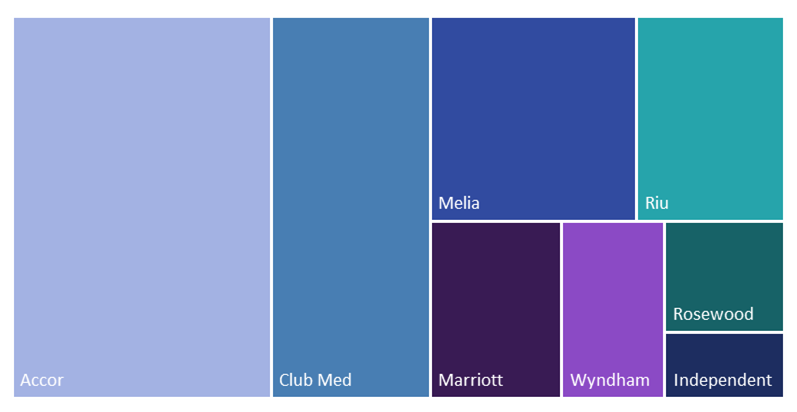
Accor, Melia, and Club Med dominate the pipeline in APAC, yet only account for some 3,300 rooms combined.
In the second part we will deep-dive into the business model, and in the third part give a comparison across traditional resorts and two all-inclusive brand specifics.
More News

AP Hospitality Bulletin Asia Pacific - August 2026


AP Hospitality Bulletin Asia Pacific - June 2026
Subscribe to our newsletter

